Saturday, August 6, 2011

Final Post

Traveling in Bhutan means unpredictable (unavailable in my case) internet service. None the less, I am back in the Western half of the country now, making preparations to leave.


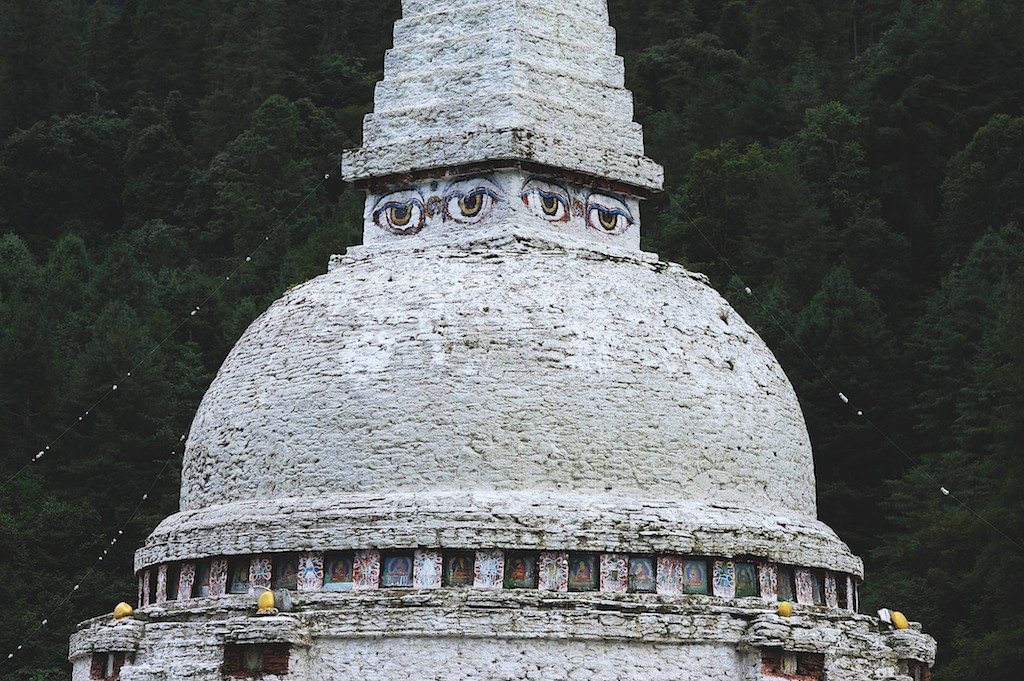
In the valley of "Ura" I visited a small monastery. The monks were attending a special ceremony up the road where a higher up lama was giving blessings, so we had a little time to kill until they returned. While we waited, my guide informed me that the people in this part of the country are renowned for their generosity.


This friendly woman approached and offered us all kinds of things including "ara." I had heard about this stuff by way of signs in the hospital warning of the dangers of alcoholism. Ara is home brewed alcohol, true Bhutanese moonshine. Now notice the size of the thermos next to this woman. It was full. Enough to flatten the entire town. Bhutanese liken ara to Japanese sake.

Well, when in Bhutan....She offers up a bowl about like what you might eat won-ton soup out of in a Chinese cafe. Holding it out, she proceeds to fill it to the brim. I take a sip and then perform an act of head and neck acrobatics, simultaneously suppressing my gag reflex, while smiling at the woman, nodding and bowing in thanks, and looking around for an escape to this predicament. And then the nausea hit as this poison reached my stomach. I was then informed by my guide that it is customary to always accept a second portion of anything offered, regardless of how small it may be, even a few drops more (I'm not kidding about this). This woman proceeded to fill my bowl up again overflowing the rim this time.

Thank God (or Buddha as the case may be) for photography. You see, I had my camera with me and almost without thinking, I grabbed it from the ledge on which it sat, brought it up to my eye, started snapping as I chased after some children running around the corner. As soon as I was out of sight I accidentally spilled my entire bowl of this wicked potion into a rain puddle. Phew.

Here is my guide Pema standing by "The Burning Lake."


Here is my driver Hamraj and our van.


We all know that these dzongs and monasteries I have shown pictures of were built hundreds of years ago, in the 7th. and 8th. centuries. Remarkable how they have stood the test of time with little in the way of restoration. Now, unless I'm mistaken, there was no running water back then. So I would like to conclude by answering that question burning in everyone's mind, "where do the monks bathe?"


So that's all for now. See you back in the states.

Wednesday, August 3, 2011

Roads

The roads in Bhutan have something less than a stellar reputation. I am here to confirm that as truth. I have now driven from Thimphu to Jakar, the main city in a region known as  Bumthang. Actually, I did none of the driving. This was left up to my driver, Hamraj who is employed  by the tour company which arranged this trip for me. We are accompanied by Pema who is my guide. He makes all the arrangements and makes sure I don't do anything too stupid.

So back to the roads. I told the tour company that I had little interest in just sitting in the van for endless hours just to reach another town and look at the local sights. We agreed that a bicycle would be brought along and I could get out whenever I wanted and ride for as long as I wanted and then be picked up again. The itinerary would be viewed as only a guideline and could be altered as mutually agreed upon by me and Pema. In any event, we drove for 5 hours one afternoon, covering a whopping 110 kilometers. For those of you math whizzes, that is an average speed of 22 km/hr, or 13.2 miles per hour.


Now you might ask how that can be when we spent the entire time on a road known as the main east to west highway in Bhutan. Well, the word highway is a bit of an exaggeration. Actually it is a complete misuse of the word to apply it to what we drove on. The slight cutout made into the side of the mountains resembled more of what a civil engineer might create in order to indicate their intent to some day construct a road there. It varied in width from 1/2 to 3/4 lane and had intermittent sections of pavement. It followed every curve of the terrain and I maintain a few extra's were thrown in there by the construction crews just for fun and to add to the challenge. The interesting part wasn't even the road itself or the rain or mud. It was the fact that this is a two lane road and an estimated 50% of the vehicles are full sized dump trucks carrying rock, dirt, cement, rebar and other construction materials. So how do cars pass each other?


I  should mention here that horn use in Bhutan is quite different than in the U.S. They are not used out of anger or frustration but rather as a communication tool and their use is encouraged. One relays a message to a slower moving vehicle in front of you that you would like to pass and they will then pull over at the next convenient place and allow you to drive by. Horns are routinely blown when entering a blind curve on the road to warn oncoming traffic of your presence. They are also used as a courtesy warning to pedestrians, livestock (commonly grazing alongside the road and for some reason lying in the middle of the road), and bicyclists. Somehow, vehicles get by each other, sometimes by no more than inches though.

So we got one flat tire on the way, changed it without any problem to the spare but have discovered that the damaged tire cannot be repaired. So we are driving with no spare until we return to the capital city in a couple days over the same road that caused a flat in the first place. Oh well, at least I have the bike to bail out onto if we get stuck. The spare bicycle tube I brought is still unused. I told Pema I would call for help when I reached the next town. Anyhow, we finally arrived in a town called Gangte, located in a wonderfully, beautiful valley in which several hundred of the endangered black neck cranes spend their Winters. I don't know that I have ever been so glad to pull into a hotel parking lot. The next day I rode the bike the 80 or so kilometers to the next town.

Friday, July 29, 2011

Edward Scissorhands

Remember that movie? I was just reminded of it while sitting in a chair in a local barbershop. Informally, one is sat down, draped in a white sheet and for lack of a better description, attacked with a pair of scissors. The cartoon sound effects of a snapping turtle resembles what it sounds like. The scissors are snapped together rapidly long before ever coming near your head. The rhythmic clacking of blades coming together rapidly continues, uninterrupted while from the other hand runs a comb seemingly randomly through your hair, while small bunches of hair shoot wildly in every direction. As if that's not enough, a brand new straight edge razor blade is then opened and seemingly carelessly slid up and down the back of the neck and around the ears. Amazingly, no blood was seen. Suddenly, all action is stopped and the first word is spoken. "Good?" I said, "great." My first $0.95 haircut and that's no lie.

Thursday, July 28, 2011

Pediatric Gastronomy

Children are picky eaters, or so the saying goes. How many times have I heard, "I don't like that. That's not kid food." Well, what exactly is kid food and what is it that makes some food kid food and other food poisonous. At what point does the child's body develop resistance or immunity to certain death from letting certain food items touch their plate?

During my travels, I have found an enlightened restaurant which has come closer to offering true kid food than any other.

For Julie

Women in Bhutan wear something known as a kira. It is simply a rectangular piece of fabric which gets wrapped 2.5 times around the waist in such a way that the final seam meets alongside the right thigh. It is held in place by a woven belt wrapped snugly thrice around the waist. Over the top is worn a tego, a short coat.


The fabrics give the outfits their dramatic look. Colors are usually brilliant and the woven patterns can be plain or ornate. They are often made of cotton, some fancy once of silk or wool.


The above description is actually for a half kira. The original, full version is similar, just cut longer and is donned in a similar fashion, the difference being that the front and back are joined with fancy broaches over each shoulder.


They are set such that the bottom hem essentially skims the ground and women are often times seen holding them up with one hand to avoid soiling them. Why not just secure them a little higher? Only a man would ask such a silly question.


Each school has its own outfit which all students are required to wear. The same fabric for both boys and girls. Boys wearing a gho, and girls in matching kira and tego.

Wednesday, July 20, 2011

Lawn Darts

This is lawn darts, Bhutanese style. The sport enjoys the status of a national sport, but was beaten out by archery for the official title. Pictured here is a tournament which took place last weekend inside the city's Olympic stadium.


The Olympics have never been held here but some supporters of sports development programs hope to become competitive in the future and this facility was built to help promote such efforts. Back to darts. It's not called that here but I don't remember the actual name.


The players were dressed in fine, silk gho's along the lines of what would be worn for very formal occasions. Only this time they were playing in the dirt. The game is played something like this. There are two opposing teams. They both stand together at one end of the "range." The range is a strip of turf about 10 or 12 feet wide and I estimate about 35-40 yards long. It is surrounded by spectators and some would say cheerleaders.

Each member of the team has I believe 3 darts to throw. The teams alternate throwing, one dart for each player and the sequence repeats until all darts are thrown. At that point, everyone goes to the other end and does it again, this time in the other direction. The target is a quite small, rectangular piece of hard foam stood upright in the dirt.


Here's the interesting part. Each time a player throws his dart, two of his teammates are standing adjacent to the target at which he aims. They are presenting the target to him, helping him aim accurately and possibly recruiting the assistance of greater beings or the wind to guide the dart to success.


Look at the pictures and note the size of the darts. They are steel tipped, weighted with wood and are hurled full speed at the target. I couldn't help but think that this must be good for generating some practice in penetrating trauma injuries for the emergency on call ophthalmologist.


Now, when one player actually hits the target, which does happen occasionally, two to four members of his team break out in song and dance to celebrate the successful throw. It's hard to tell but these guys are indeed singing and dancing. Unfortunately, I have no idea what they were singing about.


This was one spectator, too cute to pass up.

Tuesday, July 19, 2011

Now this is my kind of barbershop! What better way to assure the clean cut look of the local male population than to invite them in for a "shot and shave," a "beer and buzz," or a "tequila trim?" Now I know what you're saying, "that's just a typo, look at the misspelled name of the city." Correct, the proper spelling is Thumphu, not Thimpu. 


However, check down the street at this place. 


How about this one? More than coincidental misspellings I would think. It's about time for me to go give one of these places a try. I'll let you know how it goes. 


This is a tribute to my grandmother who, from the time I can remember, always called me Joshi.